
Optimizing Tender Reading with n8n Pipeline
𝐖𝐞 𝐮𝐬𝐞𝐝 𝐭𝐨 𝐬𝐩𝐞𝐧𝐝 𝐡𝐨𝐮𝐫𝐬 𝐚𝐧𝐚𝐥𝐲𝐳𝐢𝐧𝐠 𝐚 𝐭𝐞𝐧𝐝𝐞𝐫 𝐛𝐞𝐟𝐨𝐫𝐞 𝐰𝐞 𝐝𝐞𝐜𝐢𝐝𝐞𝐝 𝐰𝐡𝐞𝐭𝐡𝐞𝐫 𝐭𝐨 𝐛𝐢𝐝. 𝐓𝐡𝐚𝐭 𝐟𝐢𝐫𝐬𝐭 𝐫𝐞𝐚𝐝 𝐡𝐚𝐩𝐩𝐞𝐧𝐬 𝐧𝐨𝐰 𝐢𝐧 𝐦𝐢𝐧𝐮𝐭𝐞𝐬 𝐚𝐧𝐝 𝐡𝐞𝐫𝐞 𝐰𝐞 𝐝𝐞𝐬𝐜𝐫𝐢𝐛𝐞 𝐭𝐡𝐞 𝐩𝐢𝐩𝐞𝐥𝐢𝐧𝐞 𝐛𝐞𝐡𝐢𝐧𝐝 𝐢𝐭.
Public tenders are often overwhelming: hundreds of pages spread across multiple files and formats, sometimes with the requirements that decide eligibility buried in an annex. Reading through all of that just to decide whether to bid was taking valuable time before any real proposal work even started.
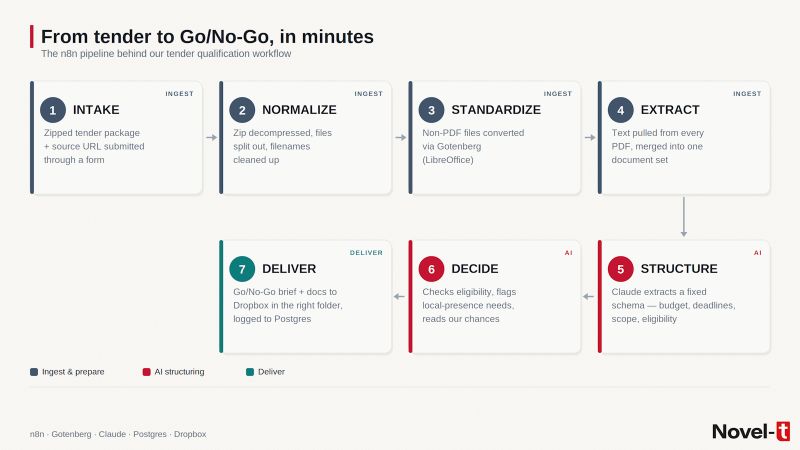
To optimize this, we implemented a pipeline with n8n. Here’s the description how we built it:
1. 𝐈𝐧𝐭𝐚𝐤𝐞: the tender package (zip of documents + source URL) comes in through a submission form
2. 𝐍𝐨𝐫𝐦𝐚𝐥𝐢𝐳𝐞: the zip is decompressed, files are split out, filenames cleaned up
3. 𝐒𝐭𝐚𝐧𝐝𝐚𝐫𝐝𝐢𝐳𝐞: anything that isn’t already a PDF gets converted through Gotenberg (LibreOffice under the hood), so every downstream step works from one format
4. 𝐄𝐱𝐭𝐫𝐚𝐜𝐭: text is pulled from every PDF and merged into a single document set
5. 𝐒𝐭𝐫𝐮𝐜𝐭𝐮𝐫𝐞: that text goes to Claude through an extraction step built against a fixed schema: title, issuing org, budget, submission/questions deadlines, contract type, detailed scope of work, and two separate eligibility checklists, administrative and technical
6. 𝐃𝐞𝐜𝐢𝐝𝐞: the same step checks whether we meet the eligibility criteria as written, flags if there are special considerations to take into account, and gives a first guess on our chances
7. 𝐃𝐞𝐥𝐢𝐯𝐞𝐫: everything is compiled into a Go/No-Go brief and filed straight into our existing Dropbox structure, in the same project folder and naming convention we already use for proposals (original documents included). It gets logged to Postgres so every tender we’ve reviewed is searchable in one place and we can perform analysis later on these tenders if needed.
The whole thing sits behind a small front end that just triggers the workflow and displays results. n8n holds all the business logic, the API is a thin pass-through to the database.
The result is a first structured read of a tender now available in minutes instead of potentially hours, and every evaluation follows the same structure.
If your team is going through the same stack of tender documents, we are happy to hear how you deal with this.
#n8n #Automation #AI #RFP #TenderManagement #PublicProcurement